Short answer: a waterless diffuser should only be loaded with fragrance formulated for cold nebulisation or with odour neutraliser, undiluted and never mixed with water. Clean it every 3 months with isopropyl alcohol, place it high, stable and away from heat, and use it in ventilated rooms at moderate intensity. If the scent stops coming out, it is almost always the nozzle, the tank or the schedule.
What a waterless diffuser is, in brief
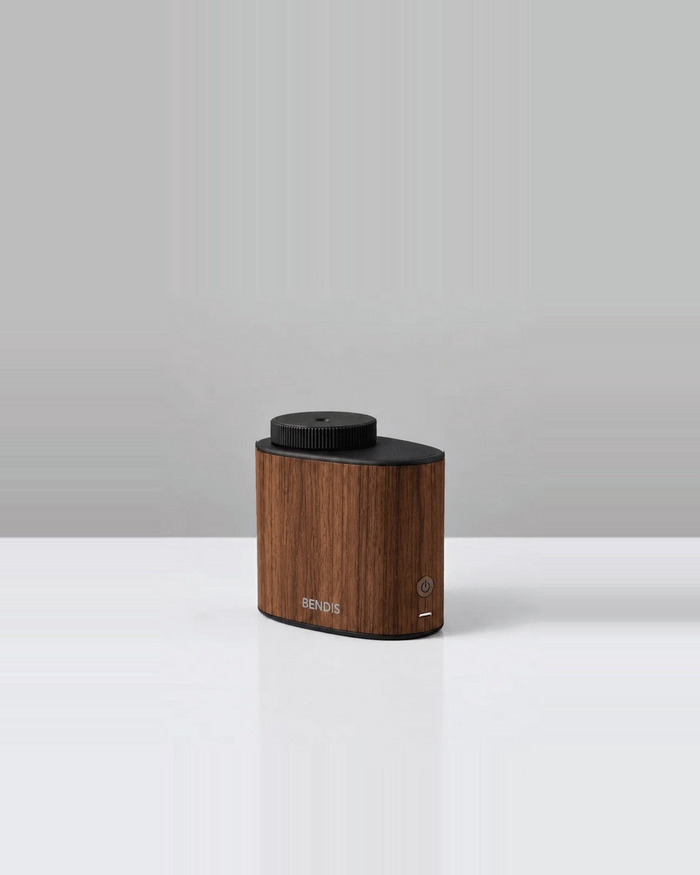
A waterless diffuser, also called a nebuliser or cold air diffuser, uses a stream of air to break the aromatic liquid into very fine particles. There is no water, no heat and no combustion. Many people search for a «waterless essential oil diffuser», but what works best in these devices is fragrance made for nebulisation. For the technical detail, see how a nebuliser works inside.
All BENDIS devices use cold nebulisation except ROAM, the car model, which works by ultrasound. This guide focuses on using them well and safely.
What you can and can't load in a waterless diffuser
| Product | Allowed? | Why |
|---|---|---|
| Fragrance formulated for cold nebulisation | Yes | It has the viscosity and concentration the device needs |
| Odour neutraliser for nebulisers | Yes | First you neutralise the bad smell, then you add scent |
| Pure essential oil | Not recommended | Often thicker and can clog the nozzle |
| Vegetable or massage oils (almond, jojoba) | No | They are thick and block the circuit |
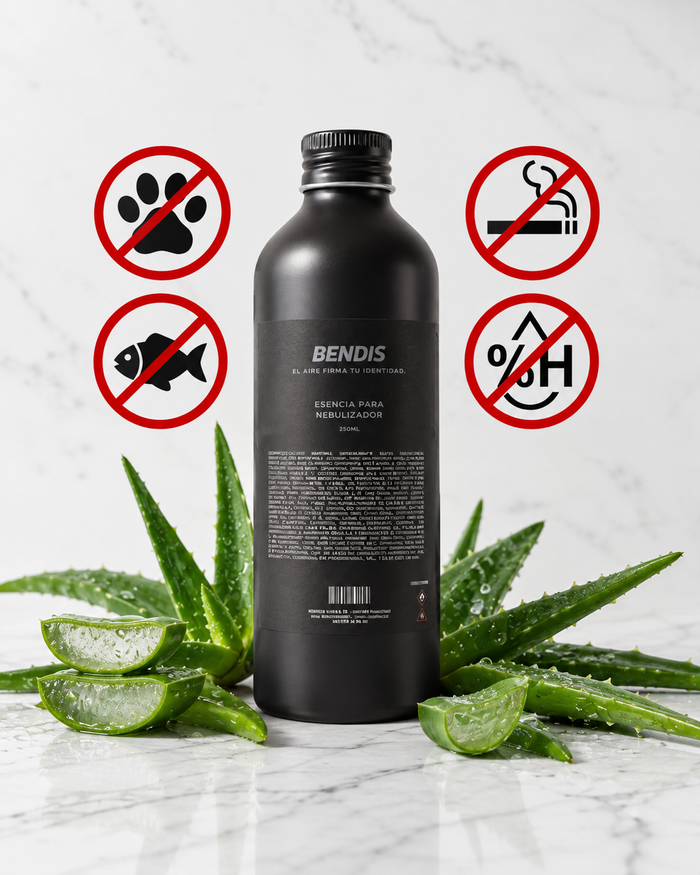
| Water, or fragrance mixed with water | No | The system isn't made for water and the nozzle clogs |
| Two fragrances mixed in the same tank | No | The result is unpredictable and mixing scents usually works against you |
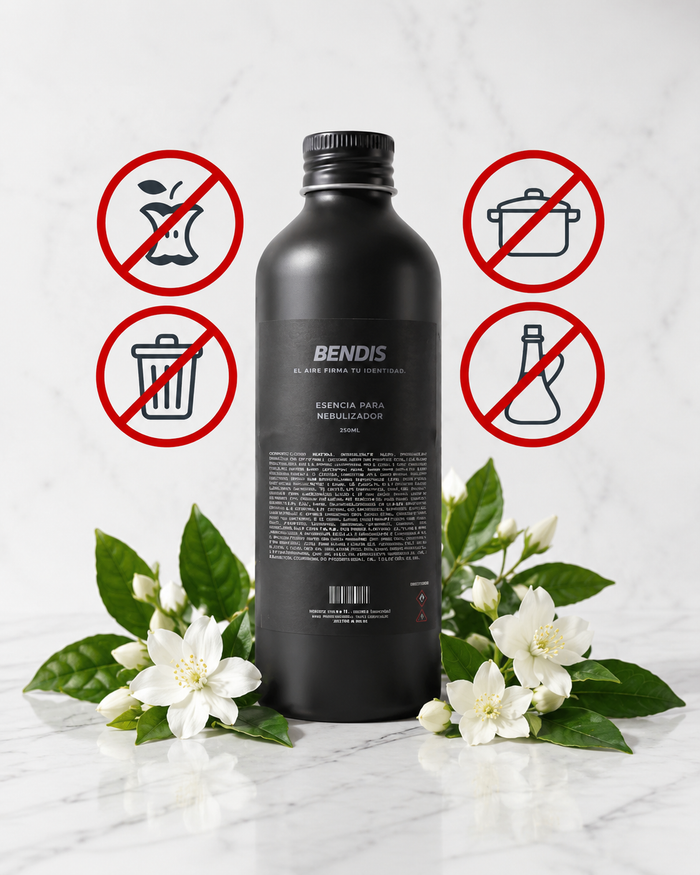
| Bleach, cleaners or spray air fresheners | No | They damage the circuit and aren't meant to be breathed in as a mist |
| Isopropyl alcohol | Only for cleaning | It dissolves fragrance residue and evaporates |
Our fragrances and neutralisers are perfumery products formulated for cold nebulisation, in 150 ml refills (€24.99 in the NATURAL line and €29.99 for the numbered fragrances and neutralisers) and 250 ml refills (€29.99 and €34.99). To understand what an essential oil is and how it differs from a fragrance, read essential oil or fragrance.
Why the fragrance is not diluted
It is the most common mistake: adding water to make a refill last longer. A nebuliser doesn't work like that. Water doesn't nebulise well, it stays in the nozzle and clogs it, and the device stops giving off scent. On top of that, what does come out smells weaker.
If the scent feels too strong, diluting is not the answer. Lower the intensity, lengthen the pauses or shorten the time slots in the app. You will use less fragrance too.
Cleaning every 3 months, step by step
A waterless diffuser has no limescale or mould, but fragrance leaves residue over time. Clean it every 3 months and every time you change scent:
- Empty the tank. Remove the bottle and pour any remaining fragrance back into its container.
- Add alcohol. Put 5 to 10 ml of isopropyl alcohol into the empty tank.
- Run it. Let it work for about ten minutes so the alcohol flushes residue from the nozzle and outlet.
- Empty and dry. Remove the leftover alcohol and let the bottle and head dry for a few minutes.
- Refill. Put the fragrance back in and you are done.
Never use water or harsh cleaners on the nozzle. Every model has its PDF manual in manuals and tutorials, and there are more tips in how to look after your BENDIS diffuser.
Where to place the diffuser
- Stable and at mid height or above. On solid furniture or fixed to the wall, out of reach of children and pets.
- Away from heat. Not next to a radiator, in direct sunlight or on top of a device that gets warm.
- Not pointing at anything delicate. The outlet shouldn't aim straight at anyone's face, at screens or at fabrics a few centimetres away.
- Where air moves but doesn't escape. A gentle airflow helps spread the scent. Right next to a street door or an open window, it gets lost.
- With the cable out of the way. If it runs on mains or USB-C, make sure nobody trips.
On premises open to the public, choose devices that lock: ORBIT has an anti theft system and HALO a tamper proof closure. More in diffusers and safety on premises open to the public.
Ventilation and intensity
A diffuser is no substitute for ventilation. Open the windows for a while every day and always start at low intensity. If anyone gets a headache, itching or discomfort, switch it off and air the room.
Watch out for olfactory adaptation: after a while you stop noticing a constant smell, even though it is still there. The typical reaction is to turn up the power, and the result is a space that smells too strong to visitors. Before turning it up, ask someone who has just arrived.
With children, pets or people with asthma or allergies, take extra care. There are specific guidelines for home in nebuliser or oil diffuser for home. For business premises, the comparison is in nebuliser or ultrasonic for a business, and the yearly cost in the 12 month cost of scenting a business.
How to store and handle refills
- Keep them closed, in a cool place, away from heat and out of reach of children.
- Do not swallow. Avoid contact with eyes and skin; if it happens, rinse with plenty of water.
- Read the label on the container before use.
- If swallowed, in Spain call the Toxicology Information Service on +34 91 562 04 20. In other countries, contact your local poison centre.
If the scent stops coming out
Before assuming it is broken, check this:
- That there is fragrance in the tank and the bottle is fitted correctly.
- Whether it is due a clean: a nozzle with residue is the most common cause.
- That the schedule is active for that time and day.
- That the batteries or power supply work, in models such as FLOW or PULSE.
- That you haven't got used to the scent, or that a bad smell isn't masking it. In that case, neutralise first.
The full list is in my diffuser isn't giving off scent: causes and fixes. If you don't have one yet and are comparing models, start with the checklist for buying a waterless diffuser.
Frequently asked questions
Can I use essential oils in a waterless diffuser?
We don't recommend it. Many are thick and clog the nozzle. The safe choice is fragrance formulated for cold nebulisation.
Can I dilute the fragrance with water to make it last longer?
No. Water clogs the nozzle and the device stops working properly. To use less, lower the intensity or shorten the schedule.
How often should a waterless diffuser be cleaned?
Every 3 months and whenever you change scent, with isopropyl alcohol. Never with water.
Can I leave it running when nobody is around?
It doesn't heat up, but the sensible thing is to schedule it only for the hours the space is in use. You use less fragrance and scent doesn't build up in a closed room.
What should I do if the scent is too strong?
Lower the intensity, lengthen the pauses between pulses and ventilate. If the device is too big for the room, switch to a model with less coverage.