Short answer: Scent marketing for hotels means choosing a fragrance that fits the brand and diffusing it in a controlled way at reception, in corridors, the spa and toilets, after neutralizing bad odours. This guide sums up each topic (what it is, zones, costs, scent signature, chain cases and boutique properties) and points you to the article that covers it in depth.
What hotel scent marketing is
It is designing and maintaining the scent of a hotel's spaces to strengthen the brand and improve the stay. It is not putting an air freshener in the bathroom. It is making sure every guest, from the front door to the room, perceives something consistent with what the hotel wants to convey.
It works because smell is closely connected to the parts of the brain that handle emotion and memory. A well chosen scent becomes linked to the hotel without the guest thinking about it. And a bad smell causes rejection before anyone can explain why.
Index: every hotel scent topic
| Topic | What it answers | Where to read it |
|---|---|---|
| Zone by zone | Which scent and intensity in the lobby, rooms, spa and restaurant | Scenting a hotel zone by zone |
| Cost of a hotel | How many units, purchase or plan, and total budget | How much it costs to scent a hotel |
| Lobby cost in Europe | Published prices for scenting a lobby | Hotel lobby scenting cost in Europe |
| Scent signature | How to choose and test your own scent, from idea to guest room | Creating a hotel scent signature step by step |
| Chain cases | What Westin, The Ritz-Carlton or Mandarin Oriental say publicly | Real cases from hotels and chains |
| Boutique and apartments | What to do with a small budget and few units | Boutique hotels and holiday apartments |
| Small hotels and rural guesthouses | How to set it up on a tight budget | Scenting small hotels and rural guesthouses |
| Hotel service | How we work with accommodation | Professional scenting for hotels |
Why hotels use their own scent
Four reasons come up again and again:
- First impression. The smell of the lobby is noticed before the decor or the service.
- Brand memory. Scent is one of the few things guests remember about a stay without having paid attention to it.
- Differentiation. Many hotels have marble, good beds and good staff. Few have a recognisable scent.
- Reviews. A stale smell, damp or smelly toilets show up in reviews far sooner than a nice scent.
Some chains take their scent into their online shop and sell it for the home. What exactly they say and what they do not is covered in real cases from hotels and chains.
Key hotel zones (summary)
- Lobby and reception: the hotel's base scent, soft and constant.
- Corridors and lifts: a continuation of the lobby, lower. Consistency between zones is perceived as care.
- Spa: can have its own scent, a little more present.
- Restaurant and bar: below the kitchen, never competing with it. In the breakfast room, better nothing.
- Shared toilets: their own unit with neutralizer.
- Guest rooms: very soft or unscented, with sensitive guests in mind.
Details for each zone, with intensities and units, are in scenting a hotel zone by zone.
How to choose the scent by type of hotel
There is no single right scent. It depends on positioning, guests and surroundings.
- Luxury and boutique: woods, soft leather, flowers with character.
- Beach and resort: aquatic notes, citrus, coconut.
- City and business: green tea, light woods, something clean.
- Rural and nature: green accords, woods, lavender.
The rule for everyone is discretion. If guests think "what a strong smell", the intensity is wrong. The full process to choose and test is in how to create a hotel scent signature, and the small budget version in boutique hotels and holiday apartments.
Neutralize first, then scent
If there is an active source (toilets, bin room, damp, rooms closed for a long time), adding fragrance does not cover it. It mixes and the result feels worse. First neutralize the source, then add scent. More in odour neutralization.
Technology: cold nebulization and HVAC
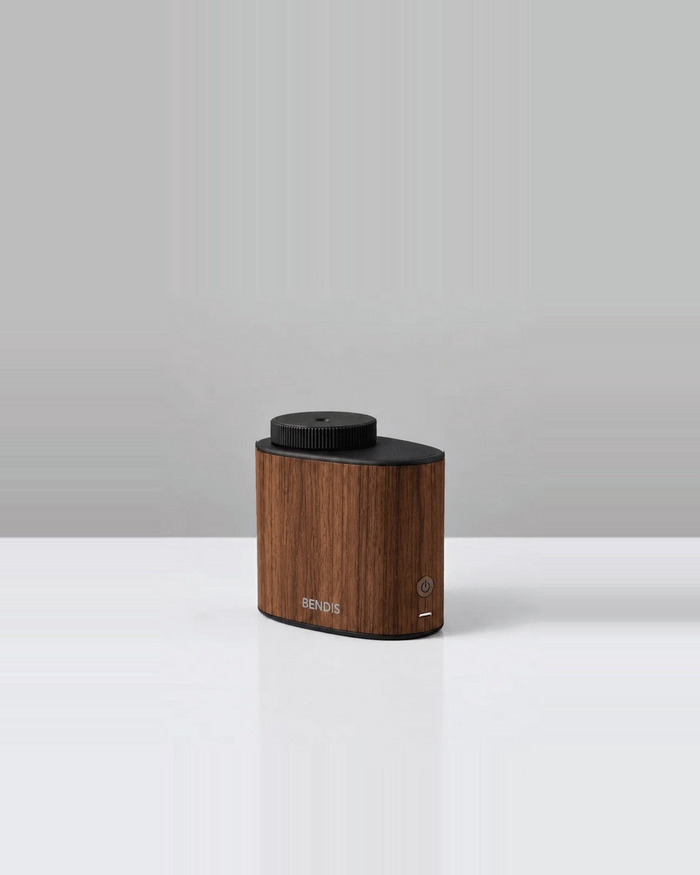
Professional units nebulize fragrance cold: no water, no heat and no dilution. They are programmed by schedule and intensity, so the lobby can run higher at check-in times and drop at night. To understand how they work, read what a professional nebulizer is.
| Use in the hotel | Unit | Coverage |
|---|---|---|
| Shared toilets and lifts | PULSE | 7 m² |
| Small reception or corridor | LUME or FLOW | 100 and 120 m² |
| Lobby or floor with public, standalone | ORBIT | 600 m² |
| Connection to HVAC ducts | ATMOS | 600 m² |
| Large spaces | HALO, WAVE, NOVA | 800, 875 and 1,600 m² |
The highest coverage units are in large format.
How much it costs to scent a hotel
It depends on zones and floor area. As a reference, units cost from €72.99 (PULSE) to €389.99 (NOVA) including VAT. With the monthly scenting plan for businesses, each unit costs €29.90 to €94.90 + VAT a month with fragrance included and no minimum term (cancel with 30 days' notice), in Spain and Portugal. Calculations by hotel type are in how much it costs to scent a hotel, published lobby prices in lobby cost in Europe and the market comparison in the professional scenting price index.
How to get started
- Walk through the hotel and note the sources of bad odours.
- Define what you want to convey and your type of guest.
- Pick three or four candidate fragrances and test them in your space.
- Decide zones and units based on the real floor area.
- Adjust intensity and schedules during the first weeks.
Frequently asked questions
What is scent marketing for hotels?
It is using a chosen, controlled scent in the hotel's zones to strengthen the brand and the guest experience, starting by neutralizing bad odours.
Which hotel zones should be scented first?
Lobby and reception, plus shared toilets with neutralizer. Then corridors, spa and common areas. Guest rooms last and very softly.
How much does it cost to scent a hotel?
Each unit can be bought from €72.99 or paid through a plan from €29.90 + VAT a month. The total depends on the zones. We break it down in this cost article.
Can a small hotel have its own scent?
Yes. One or two well placed units and a consistent scent are enough. We cover it in boutique hotels and holiday apartments and, on a tight budget, in scenting small hotels and rural guesthouses.
Do the units need building work?
Standalone units do not: they sit on a surface or mount on a wall. If you prefer to diffuse through the HVAC ducts, the model designed for that is ATMOS.
Shall we talk about your hotel? Call 911 09 70 50 or write to info@bendis.es. You can also see our business service and the diffuser catalogue.