Short answer: reed diffusers, candles and sprays fail because of physics, not brand. A reed diffuser relies on slow evaporation that loses strength; a candle only scents near the flame and while it burns; a spray releases droplets that fall within minutes. And your nose gets used to a constant smell. That is why they reach one corner, for a while, and not the whole room.
Here we explain the technical reason. If you already have it clear and want to know what to buy, skip to the end: we leave you the right guide for each case.
Three concepts to understand any air freshener
- Evaporation: how much fragrance passes from the liquid into the air and how fast.
- Coverage: how far that fragrance reaches in the room, in floor area and volume.
- Olfactory saturation: how long it takes your nose to stop noticing a smell that does not change.
A good scent system has to solve all three at once. Traditional air fresheners solve one at most.
The reed diffuser: evaporation that fades away
The liquid rises through the reeds by capillary action and evaporates at their surface. Nothing pushes the scent out: it depends on temperature, air movement and how much surface the reeds have.
It has three technical problems:
- The fragrance changes over the days. A fragrance is made of lighter and heavier notes. The light ones evaporate first, so what is left in the bottle smells different and weaker.
- The reeds clog. With dust and the denser components, they draw up the liquid less and less well.
- It emits little, from one spot. With heating, air conditioning or an open window, the little scent it releases is diluted before it reaches you.
Flipping the reeds gives a brief burst of smell, but it does not change the physics of the system.
The candle: heat that only reaches nearby
The flame melts the wax and that warm pool evaporates the fragrance. The scent starts from a very small point and spreads through the room slowly and unevenly, so it smells up close and little further away. Once blown out, it stops emitting.
It also needs supervision: it cannot be left alone or placed near curtains. It is an object for a moment, not a system for keeping an atmosphere.
The spray: droplets that fall
A spray releases a cloud of droplets all at once. Many of those droplets are relatively large and heavy, so they fall to the floor and furniture quite quickly. What stays in the air is diluted by ventilation.
The result: a very strong peak of smell when you press and, a while later, nothing. If you repeat, you load the air without achieving stability. And on small surfaces it can leave a residue.
Plug-ins and ultrasonic diffusers: better, but with limits
A plug-in air freshener heats a refill. It emits more steadily than a reed diffuser, but always from the same spot and at low height, so it concentrates the smell around the socket.
An ultrasonic diffuser vibrates water with a few drops of oil or fragrance and turns it into vapour. It has two limits: the fragrance is diluted in water, so it arrives with less intensity, and the damp mist tends to settle near the device.
Olfactory saturation: why you stop noticing it
Your nose adapts to smells that do not change. Shortly after being in a room with the same scent, your brain stops paying attention to it. That is why two typical things happen:
- You think the reed diffuser no longer smells, but someone coming in from outside does notice it.
- You turn up the intensity so you can notice it, and the air ends up heavy for everyone else.
The technical solution is not more quantity, but diffusing in pulses (a few seconds on, a few off) and at low intensity. That keeps the scent present without the nose saturating so quickly.
Coverage: a question of volume
A room is not a surface, it is a volume of air. To scent it, the fragrance has to spread through all that air and stay suspended. A weak, fixed emitter (reed diffuser, candle, plug-in) does not reach. A single burst (spray) reaches for a moment and falls.
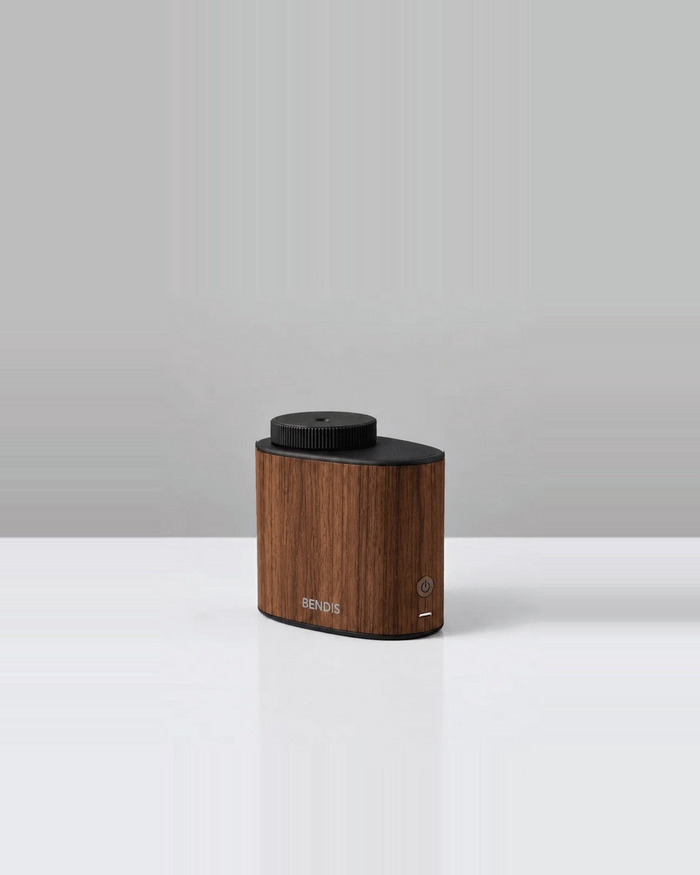
That is why nebuliser manufacturers state coverage in square and cubic metres. The BENDIS LUME, for example, covers up to 100 m² (about 250 m³).
What makes a cold-air nebuliser different
It uses pressurised air to atomise the fragrance without water and without heat. The particles are very fine, stay floating and spread through the volume. It works in pulse and pause cycles, programmed by schedule and intensity, which is exactly what avoids olfactory saturation. More detail in what a professional nebuliser is and how it works.
And one rule that applies to any system: if there is a bad background smell, neutralise first and then add a scent. Otherwise the fragrance mixes with it. See which neutraliser to choose by smell.
So, what to buy
- You want to know what lasts longest and what it costs per month: the air freshener that lasts longest.
- You want to compare devices by price and square metres: comparison by price and coverage.
- You want to know what to put in each room: air freshener by room.
- You want to programme it properly: automatic and programmable air fresheners.
- It is for a business: why commercial premises cannot be scented with air fresheners.
Frequently asked questions
Why does my reed diffuser no longer smell?
For two reasons at once: the lighter notes have evaporated and the reeds draw up the liquid less well, and your nose has also got used to it. Someone coming in from outside may still notice it.
Does flipping the reeds work?
It gives a burst of smell for a while because you expose the soaked end. But it does not change the evaporation rate or the coverage.
Why does a spray smell for such a short time?
Because it is a single burst. Many droplets fall onto the floor and furniture, and what stays in the air is diluted by ventilation.
What is olfactory saturation?
The nose adapting to a smell that does not change. After a while you stop perceiving it even though it is still there. That is why it is best to diffuse in pulses and at low intensity.
Is an ultrasonic diffuser the same as a nebuliser?
No. An ultrasonic diffuser dilutes the fragrance in water and makes vapour. A cold-air nebuliser atomises the fragrance without water, using pressurised air.