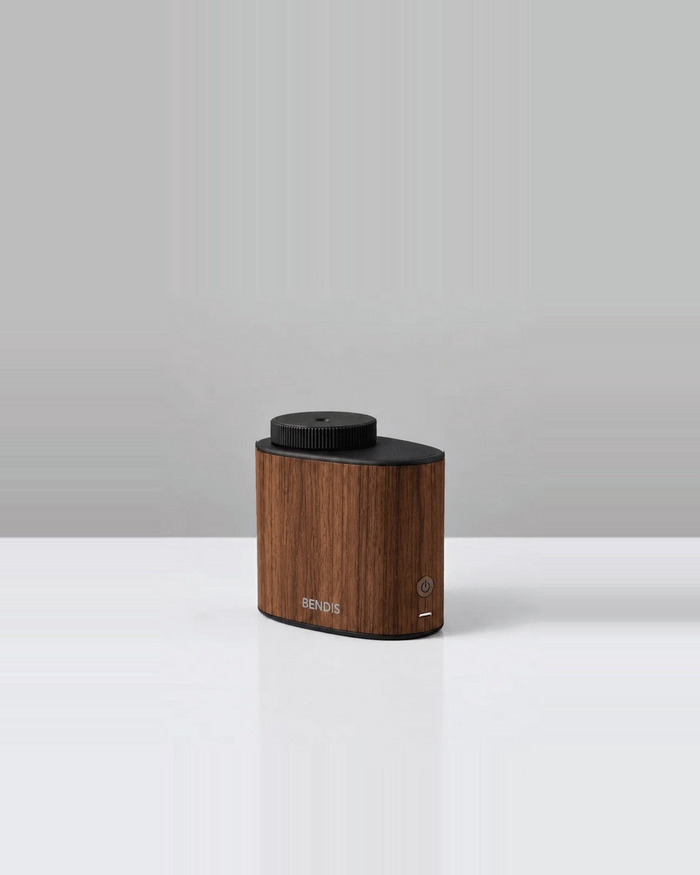
Short answer: a programmable automatic air freshener releases fragrance on its own, at the times and intensity you choose. The most basic ones fire a dose every so often. BENDIS nebulisers are programmed with the BENDIS app by time slot, day and intensity, and some switch on with a presence sensor. The most common mistake is leaving it running 24 hours at maximum power.
This guide covers how they work and how to programme them. If you want to know which device to put in each room, see which air freshener to use in each room. If you are comparing price and square metres, see the comparison by price and coverage.
Types of automatic air freshener
| Type | How it decides when to diffuse | Control |
|---|---|---|
| Wall-mounted aerosol dispenser | One burst at a set interval | Fixed interval, sometimes day or night |
| Plug-in with timer | Heats the refill continuously or in cycles | Very basic |
| Ultrasonic diffuser with timer | Runs for a few hours and switches off | On time |
| Nebuliser with presence sensor | Switches on when it detects someone | Automatic based on use |
| App-programmable nebuliser | Time slots, days and work and pause cycles | Full: schedule, days and intensity |
| Nebuliser connected to air conditioning | Diffuses through the air ducts | Full, for large spaces |
How to programme a nebuliser
Almost all nebulisers work the same way: they diffuse for a few seconds, pause, and diffuse again. This is called the work and pause cycle. With the app you adjust three things:
- Time slots. From what time to what time it runs. You can create several a day.
- Days. Weekdays, weekends or every day.
- Intensity. How much it diffuses in each cycle. At home, low or medium is almost always enough.
BENDIS nebulisers are programmed with the BENDIS app, free for iPhone and Android. The LUME, SENSE, AURA 5 and FLOW connect via Bluetooth, and the schedule is stored in the device. The FLOW also shows its settings on its display. The AURA 5 has 5 intensity levels and 6 time slots, and also lets you alternate between its five fragrances by schedule.
Programming examples
| Case | Suggested schedule |
|---|---|
| Home, weekdays | One slot from when you get back from work until night, low intensity |
| Home, weekends | Morning and afternoon, with a break at midday if you air the house |
| Bedroom | A while before going to bed and off overnight |
| Business | From shortly before opening until closing, off on closed days |
Tip: set the start a little before you arrive or open. That way the atmosphere is ready when you walk in.
Battery, batteries or mains
- Batteries: the FLOW lasts up to 81 days on batteries and covers 120 m². Ideal for hallways, empty flats or places without a socket.
- Battery and sensor: the PULSE runs on one D battery and its radar sensor switches it on when someone comes in. It does not need schedules. For bathrooms up to 7 m².
- Rechargeable battery: the ROAM, for the car, with up to 50 hours of battery life.
- Mains or USB-C: LUME and SENSE. Nothing to replace, but they need a socket nearby.
The most common programming mistakes
- Leaving it 24 hours at maximum. It uses a lot, saturates the air and in the end you stop noticing it because your nose gets used to it. Better to use time slots and low intensity.
- Programming it when nobody is there. Apart from a short while before you arrive, that is wasted refill.
- The same intensity everywhere. A bedroom does not need the same as a living room.
- Not checking the device's clock. After a power cut or a battery change, check the schedule is still right.
- Placing it under the air conditioning or next to an open window. The scent is carried away before it spreads.
- Adding scent on top of a bad smell. Neutralise first and then add a scent. See which neutraliser to choose.
- Forgetting to clean it. Every 3 months, so it keeps atomising properly.
Programming it well also makes the refill last longer. How long it lasts and what it costs per month is in the air freshener that lasts longest.
Automatic air freshener for a business
In commercial premises programming matters even more: the scent has to be the same at 10 am as at 8 pm. For large spaces there are devices such as the ORBIT (600 m², with radar sensor) or the ATMOS (600 m², connects to air conditioning). With the monthly scenting subscription you get the device and fragrance included, from €29.90 to €94.90 + VAT per month depending on the device. Why a household air freshener does not work in commercial premises is explained in professional scenting versus air fresheners.
Frequently asked questions
How do you programme an automatic air freshener?
On BENDIS nebulisers, from the BENDIS app: you choose time slots, days of the week and intensity. Aerosol dispensers only allow a fixed interval.
Which app do BENDIS diffusers use?
The BENDIS app, free for iPhone and Android. With it you programme schedules, days and intensity over Bluetooth, without creating an account.
Is an automatic air freshener better with batteries or mains power?
With batteries you can put it anywhere, like the FLOW, which lasts up to 81 days. With mains power you never need to replace anything. It depends on whether you have a socket nearby.
How many hours a day should it run?
The hours when people are there, starting a little before. At home, on low intensity, a few hours in the afternoon and evening is usually enough.
What does the presence sensor do?
It starts diffusing when it detects someone. It works very well in bathrooms, because it only uses fragrance when the room is in use.