There is one sentence no restaurant wants to hear: "I got home and my jacket smelled of your kitchen." Frying smells carry grease particles that settle on fabrics and surfaces, which is why they linger for so long.
Extraction comes first
Before you buy any scenting equipment, check three things in the kitchen:
- That the hood moves enough air for the output of your fryer and griddle.
- That the hood filters are cleaned as often as they should be. A saturated filter lets grease straight into the duct.
- That the kitchen is under negative pressure relative to the dining room. If the dining room takes in more air than the kitchen, the smell stays put. If it is the other way round, it always crosses over.
That last one is the most overlooked and the one that changes the result most.
The doorway is the key point
The smell reaches the dining room through the kitchen door, not through the walls. Putting a neutralising unit in that doorway, running in short cycles during service, cuts a good part of the problem before it reaches the tables.
A swing door kept closed and an air curtain, if the premises has one, finish the job.
What not to do
Do not flood the dining room with sweet fragrance. Airborne grease does not disappear because you pour vanilla over it; all you achieve is a customer smelling fried food with vanilla, which is worse. Fragrance is for the entrance, and for the dining room once you have stopped the smell crossing over.
Washrooms are a separate job
In restaurants that fry a lot, washrooms tend to build up smell from the air of the premises itself. That calls for a neutraliser on short cycles, independent of the dining room unit.
Which equipment
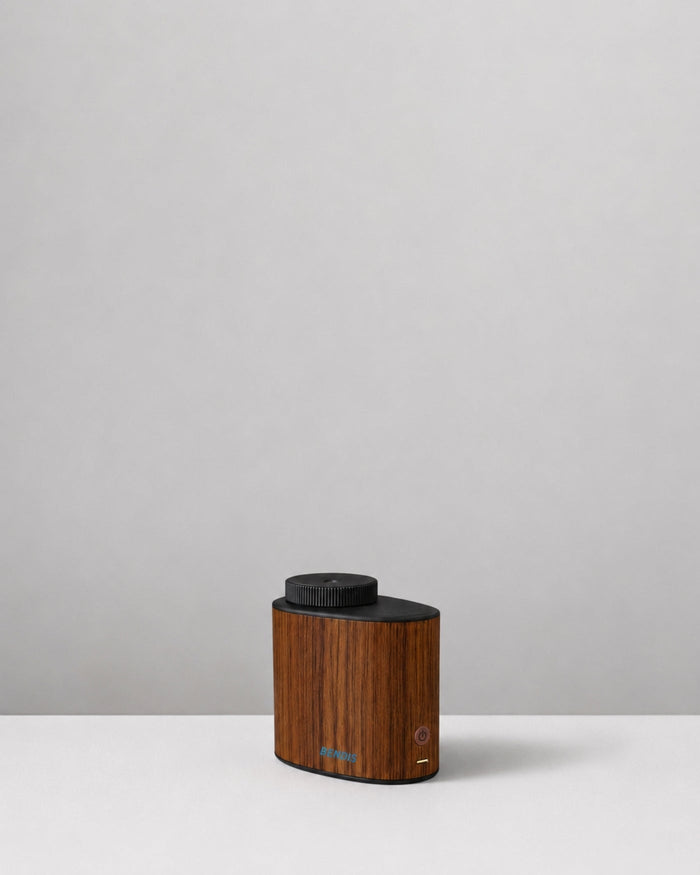
A compact unit mounted high up is enough for the doorway. For the dining room, coverage is chosen by floor area: up to 120 m² for a small room, 600 m² or more for large ones. You will find the range in the diffuser catalogue and the most common questions in our FAQ.
An honest test
Hang a cloth napkin in the dining room through a full service and smell it the next day. It is the same kind of fabric as your customers' clothes, and it tells you better than your own nose whether the problem is still there.
Tell us how your premises is laid out at info@bendis.es and we will tell you where each unit should go.