There is one factor almost nobody looks at when buying a diffuser, and it decides whether you will end up switching it off: noise. In a living room it makes no difference. In a bedroom, a treatment room or a meeting room, it does.
Why diffusers make noise
Every technology has its own source of noise.
Ultrasonic units. They run on water, and water is audible: the bubbling in the tank and the sloshing as the level drops. Many of them also add a small fan to push the mist out.
Automatic aerosol air fresheners. They do not hum, but they fire a shot every few minutes. In a quiet room that is worse than a constant hum, because the ear adapts to continuous sound and not to intermittent sound.
Nebulizers. They have an air pump, and that is where their noise comes from. The difference between a good unit and a bad one lies mainly in how well that pump is isolated from the housing: much of what you hear is not the pump, it is the vibration transmitted to the furniture it stands on.
What you can do yourself
Before changing your equipment, try this, which solves most cases:
- Stand it on something soft. A felt or cork mat under the unit removes the vibration transmitted to the furniture. It is the change you notice most and it costs nothing.
- Do not put it on a hollow surface. A thin piece of furniture acts as a sounding board.
- Keep it away from the headboard. In a bedroom, at a medium distance and not on the bedside table: the scent still reaches you, the noise does not.
- Turn the intensity down. Lower output means less work for the pump and less noise. And in a bedroom the correct intensity is the lowest one anyway.
- Programme it to switch off. Let it work before you go to bed and shut down on its own afterwards. That way the scent is there and the machine is not.
Where it matters more than you would think
Bedrooms. The obvious one. And not only the noise: the light as well. A blue LED on a bedside table is as annoying as a hum.
Clinics and treatment cabins. A physiotherapy, beauty or psychology session with a device humming away in the background loses a great deal. Here the unit is better placed outside the cabin, in the corridor or at reception, letting only the scent come in.
Meeting rooms. Continuous background noise is tiring in a long meeting and it shows on a video call, where the microphone picks it up even when you have stopped hearing it.
Libraries, coworking spaces, study areas. The standard here is high and any audible device ends up unplugged by somebody.
The general rule
In a quiet space, the unit goes outside the sensitive area and runs at low intensity. Scent travels; noise does not have to. Scenting the corridor is more effective than scenting the room.
And if you are about to buy, ask for the noise figure in decibels, not in adjectives. "Silent" means nothing at all.
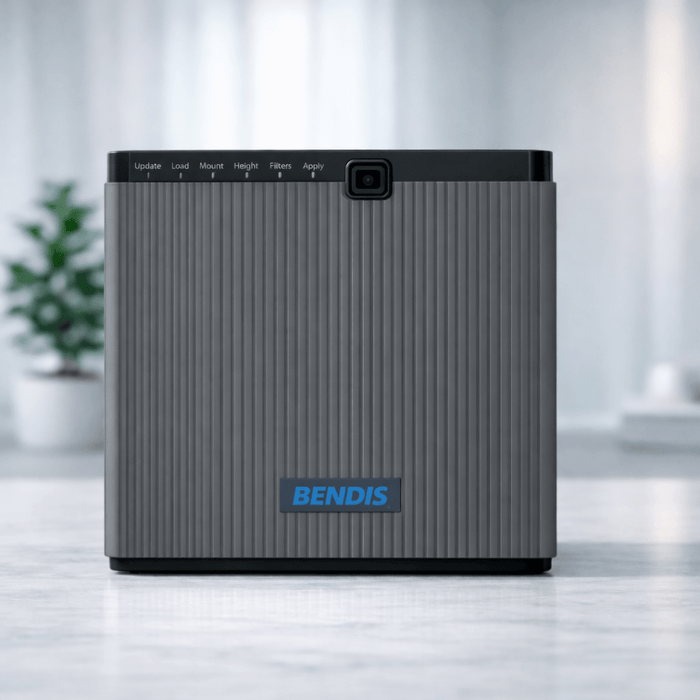
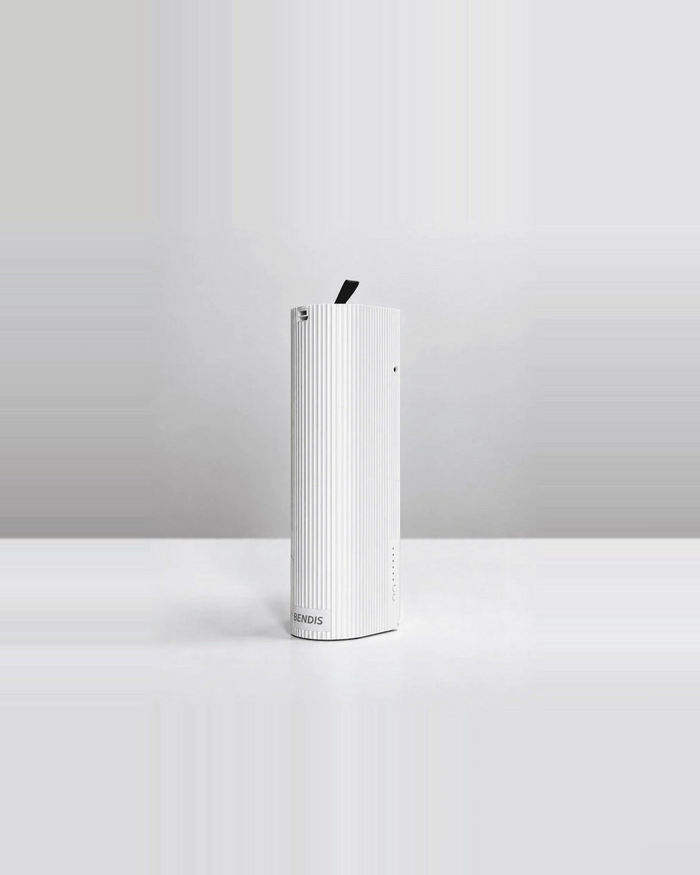
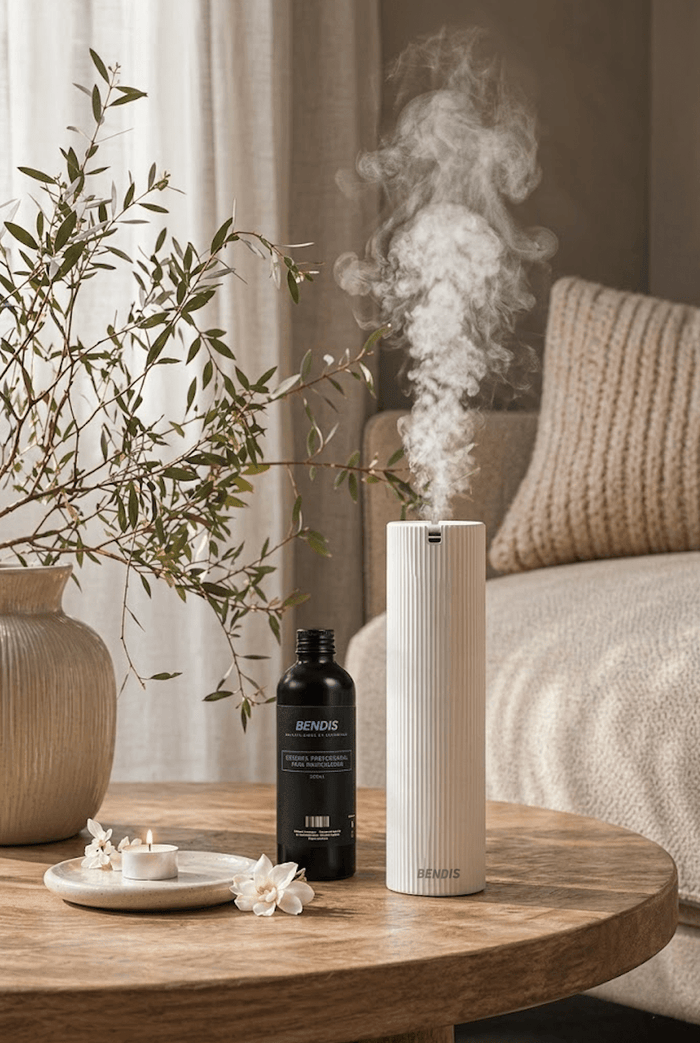
The BENDIS units
Our nebulizers work without water, so there is no bubbling and no mist fan, and they are programmable by schedule and intensity, which is what lets you leave them working only when it suits you.
If noise is your main criterion, the model is the SENSE: it is rated at ≤ 30 dB and covers 80 m², which is the combination you want in a bedroom or a clinic room. Above that, the LUME sits at ≤ 38 dB and the HALO and the ORBIT at ≤ 40 dB, designed for spaces with activity in them.
The figures for each model are on its product page, in the diffuser catalogue. And if your case calls for placing it outside the room, we will tell you so: contact · info@bendis.es