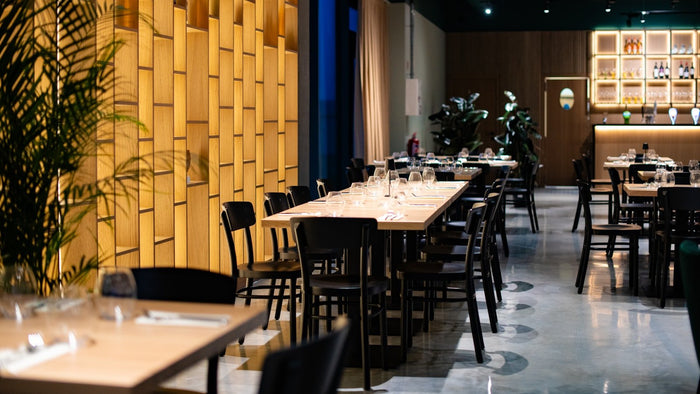
A completely open terrace cannot be scented consistently: the air is renewed too quickly. It does work on covered terraces or those enclosed at the sides, inner courtyards, entrance areas and sheltered corners, with the device next to the facade, downwind and programmed only during terrace hours.
Let's start with the honest part: on a completely open, windy terrace, a scented atmosphere cannot be maintained. Outdoors there is no volume to fill, only a draught that carries the scent away. What you can do is work on specific zones and specific moments.
Where it works
- Covered terraces or those with an awning closed at the sides. Here there is enough air containment for the scent to be perceived.
- Entrance areas. The passage between street and venue, the arch into the garden or the waiting area are points where scent really makes a difference. Better to concentrate there than to try to cover everything.
- Inner courtyards and spaces surrounded by walls.
- Sheltered corners within a large terrace: lounge area, private area, area next to the facade.
- Porches, pergolas and verandas of homes, with at least two closed sides.
Where it does not
On an open pavement terrace, with traffic and wind, the product is gone before it reaches anyone. Nor is there any device that can scent an open garden evenly. There, the sensible thing is not to spend on ambient scenting and to concentrate the effort on the venue's entrance.
What to expect by type of terrace
| Type of terrace | Is it worth it? | Approach |
|---|---|---|
| Open pavement | No | Scent the venue's entrance |
| Open with awning | Not much | Only the area next to the facade |
| Covered and closed at the sides | Yes | Like an indoor space, with slightly more intensity |
| Inner courtyard | Yes | Device next to a wall, protected from rain |
How to place it
- Downwind of the prevailing wind, never upwind.
- Next to the facade or an enclosure, not in the middle of the terrace.
- At mid-height, protected from direct rain and full sun.
- With higher intensity than indoors and more frequent cycles, because the air is renewed sooner.
By type of business
- Restaurants and bars with a terrace. The terrace is the summer asset. Scent works better at the entrance and in the waiting area than spread across the tables, and a clean profile does not interfere with the food. More in scenting for restaurants.
- Hotels with outdoor areas. Pool, garden, bar terrace. The most effective approach is usually to scent the transitions from indoors to outdoors, not the outdoors itself. More in scenting for hotels.
- Gyms with an outdoor area. A fresh citrus profile fits the activity. Changing rooms, where the real problem is, are handled separately with a neutraliser.
The case of citronella
On summer terraces citronella is one of the most requested scents, and for good reason. Its citrus and herbal profile is associated with freshness: it does not lower the temperature, but it improves perceived comfort in a hot space, just as menthol gives a cold sensation without cooling anything. It fits the season without the customer thinking about it, and on a restaurant terrace it does not compete with the food.
One thing should be made clear. In the European Union, a product sold to repel insects is a biocide and needs specific authorisation. Our Citronella refill is a perfumery composition for ambient scenting, not an authorised repellent, and we do not sell it as such. If you need real protection against mosquitoes, what you need is a registered repellent or a pest control solution.
It is used like any other profile, with the same limitation: it needs some air containment to be noticed. You may also be interested in which fragrances to use in summer in a business and how to adjust the device.
Odours coming from outside
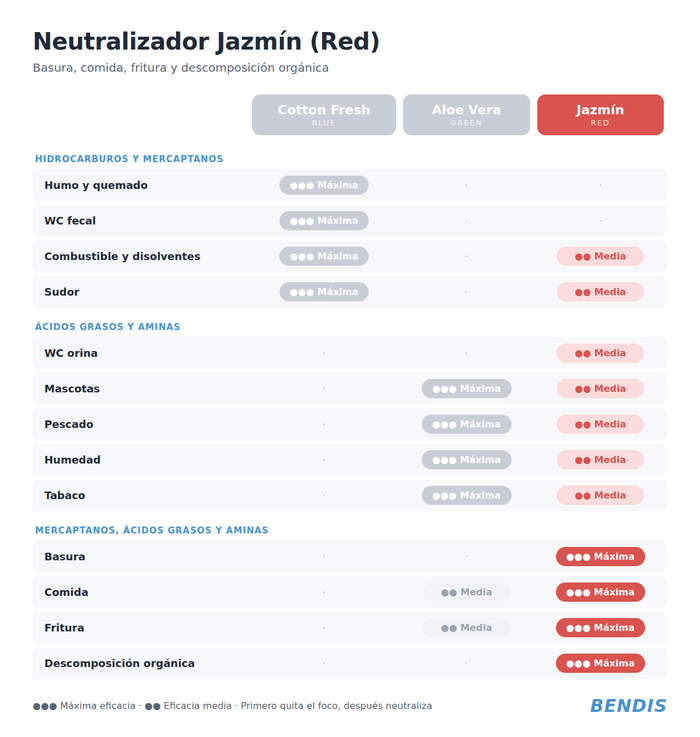
Sometimes the problem with a terrace is not that it smells of nothing, but that it smells bad: nearby bins, a drain, the kitchen's smoke outlet. In hot weather, the bin room and drains smell much more, and adding citronella on top does not mask it: it mixes and makes it worse. In those cases, a neutraliser works better than a fragrance in the covered area. The Jasmine neutraliser is formulated for rubbish, food and drains.
Device and consumption
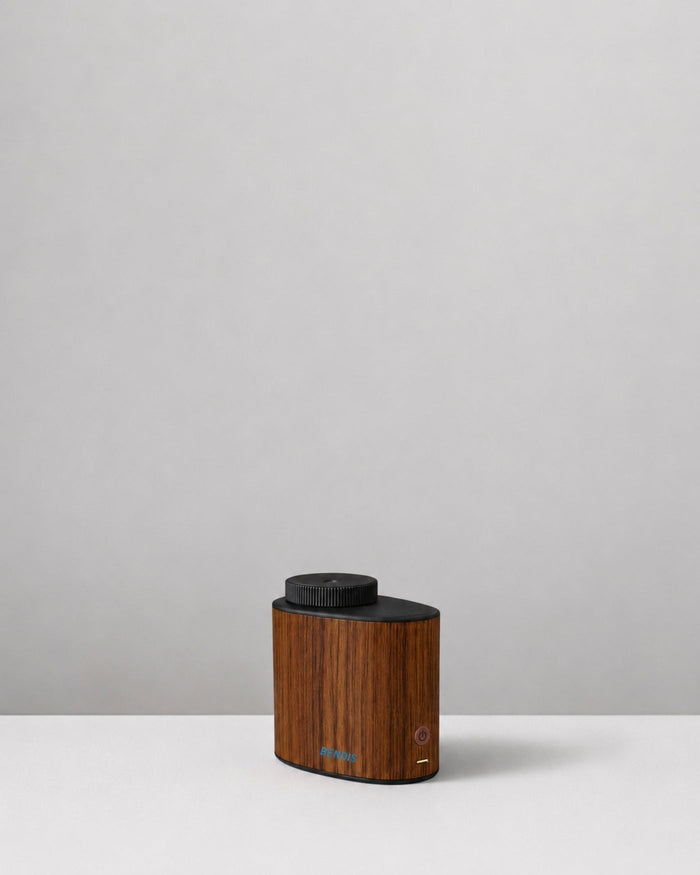
Outdoors, consumption rises, so a device with a large reservoir is advisable so you are not changing the bottle every week. A domestic ultrasonic device is no use here. The BENDIS FLOW has a 500 ml reservoir and runs on batteries or USB-C, so it does not need a socket on the terrace. For large covered areas there are mains-powered devices from 600 m² upwards.
And strict scheduling by time slot: only during terrace hours, never in the early morning. You can see the models with the largest reservoirs and coverage in the diffuser catalogue.
Realistic expectations
Outdoors, the goal is not for the whole terrace to smell the same, but to create pleasant points along the customer's route. With that set out from the start, the result is convincing. Approached as "I want my terrace to smell like my dining room", it is not.
If you tell us what your terrace is like (square metres, whether it is covered or closed at the sides, how much draught) at info@bendis.es, we will tell you honestly whether it is worth it and where to place the device. Sometimes the answer is no.
Frequently asked questions
Can an open terrace be scented?
Not consistently. With wind and open air the scent disperses immediately. What does work is scenting sheltered areas and the venue's entrance.
Can the diffuser withstand the weather?
It is not designed for rain or direct sun. Place it under cover, protected and on a stable surface.
Does citronella keep mosquitoes away?
It is the scent most associated with summer outdoors, but it is not an insecticide and does not replace an authorised repellent. What it provides is the characteristic smell and a feeling of freshness in the covered area.