Short answer: building scent into an interior design project means deciding three things: where the devices go (near the entrance and in dwell areas, with a power point and access), how the scent is diffused (standalone in the room or connected to ducted air conditioning) and whether the device is hidden or left on show. All of that goes into the drawings and the budget.
This guide is for architects, interior designers and decorators of commercial spaces. If what you need is to choose the fragrance, go to how to choose your brand scent. If you are the company and want to roll it out, see how to create your company's odotype.
Why scent belongs in the interior design project
A space is designed for the eye: materials, light, colour, furniture. More and more projects also work on sound. Smell tends to be left out, and is later solved with whatever the client finds first.
The result is familiar: a diffuser plugged in on top of a designer piece of furniture, a visible cable or a fragrance that has nothing to do with the space. If scent comes in at the project stage, all of that is avoided. And the fragrance becomes part of the identity of the space, what in branding is called an odotype.
Where to place diffusers in a commercial space
- Near the entrance, but not in the doorway. That is where the first impression forms. Right on the threshold, the air coming in and going out carries the fragrance away.
- In areas where people stay. Fitting rooms, waiting area, bar, reception.
- Away from extraction. An extract grille nearby sends the fragrance outside before it spreads.
- With a planned power point. Devices run on mains power (12 V) or USB-C, depending on the model. Plan the socket in the exact spot so no cables cross the room.
- With access for maintenance. The fragrance needs refilling and the nebuliser needs cleaning every 3 months. A device inside a false ceiling with no access hatch is a problem.
- Not aimed at anything a few centimetres away. Keep the outlet clear, not right against a fabric, a painting or a wall.
- With WiFi or Bluetooth coverage. Schedules and intensity are programmed from the app.
- Neutraliser in toilets and odour-prone areas. You neutralise first and scent afterwards. More in odour neutralisation.
In partitioned spaces, several small devices are better than one large one in a single room.
Integration with air conditioning: ATMOS and HVAC
In buildings with ducted air conditioning, scent can travel with the air. It is the most even way to cover large areas and it keeps rooms free of devices.
- BENDIS ATMOS: covers up to 600 m², connects to the air conditioning ducts and accepts an external fan to extend its reach. 1,000 ml tank, 12 V, 45 dB or less, app control.
- BENDIS HALO: up to 800 m², also supports connection to air conditioning and additionally diffuses 360° directly into the room.
Three things to bear in mind:
- Coordinate with the HVAC installer on the connection point and access to the device.
- Scent only spreads when the air is moving. Programme the diffuser for the same time slots in which the air conditioning runs.
- If there are no ducts, the alternative with the same coverage is the BENDIS ORBIT, standalone, on a surface or wall-mounted.
We explain how a nebuliser works inside in what is a professional nebuliser.
Device aesthetics: hide it or show it
| Approach | Device | Useful project data |
|---|---|---|
| Invisible, via ducts | ATMOS | 600 m², HVAC connection, takes up no room space |
| On show, refined finish | HALO | 800 m², acrylic and steel, touch panel, tamper-proof lock |
| Floor tower in a lobby | WAVE | 875 m², titanium finish, 107 × 107 × 550 mm, no building work |
| Large-format floor tower | NOVA | 1,600 m², aluminium casing, 186 × 186 × 650 mm, no building work |
| Standalone in public areas | ORBIT | 600 m², surface or wall, radar sensor, anti-theft |
| Discreet on a wall or furniture | LUME | 100 m², wall or table, 38 dB or less |
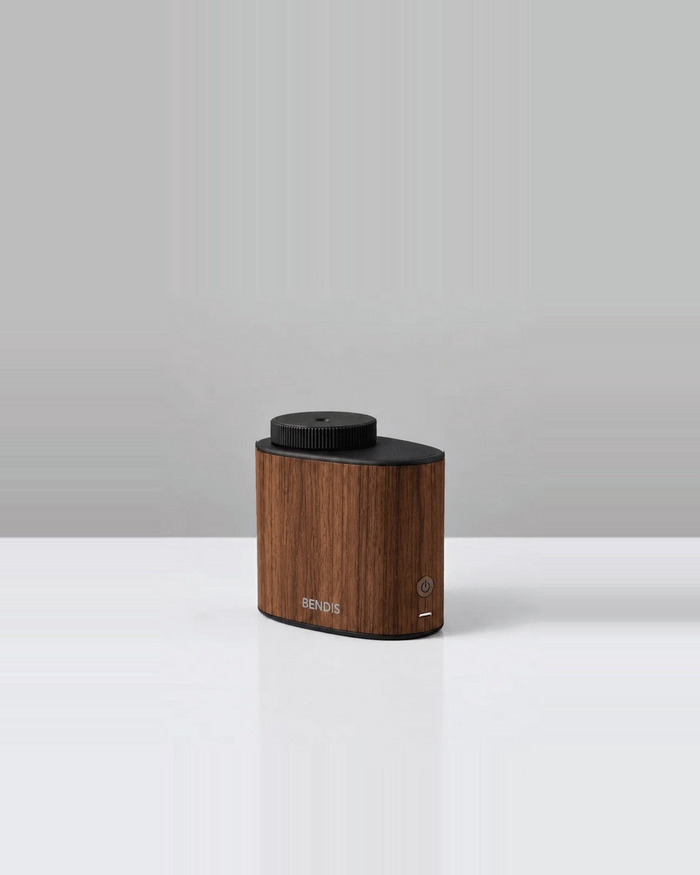
| Consulting room or quiet room | SENSE | 80 m², wood-effect finish, 30 dB or less |
| Cable-free | FLOW | 120 m², batteries (up to 81 days) or USB-C |
For rooms where noise matters, there is more detail in diffusers and noise. The full large-coverage range is in large format.
Matching fragrance and space
A scent that does not match what people see creates a dissonance customers notice even if they cannot explain it. Some starting guidelines:
- Minimalist and contemporary: clean registers, citrus, green or aquatic.
- Warm materials, wood, textiles: soft woody scents.
- Boutique hotel or space with character: woody or oriental, at moderate intensity.
- Restaurants: registers that do not compete with the kitchen; at the entrance and in toilets, neutralisation plus a fresh note.
- Offices: citrus or green, at low intensity, because people spend many hours inside.
The full table with specific fragrances is in how to choose your brand scent.
How to present scent in a project
- Design statement: a scent concept section with the feeling sought and the chosen family.
- Drawings: location of each device, power point and, where applicable, duct connection.
- Technical sheet: model, coverage, noise level, power supply and finish.
- Samples: bring 5 ml samples of the two or three proposed fragrances to the presentation, just as you bring material samples.
- Budget: device purchase (from €59.99 to €389.99 VAT included) or a scenting subscription from €29.90 to €94.90 + VAT per month, with device and fragrance included and no minimum term, with 30 days' notice. Full prices in the price index.
If you would like help sizing a project, write to info@bendis.es with drawings and square metres. More on our business service.
Frequently asked questions
Where should a scent diffuser go in a commercial space?
Near the entrance without being on the threshold, in areas where people stay and away from extraction. Always with a planned power point and access for refilling and cleaning.
Can a diffuser be connected to the air conditioning?
Yes, with models designed for it such as ATMOS or HALO. The connection point is agreed with the installer and the diffuser is programmed for the times the air conditioning is running.
Does installing a professional diffuser require building work?
For most models, no: they go on a surface, on a wall or stand on the floor. Connecting to ducts does require coordination with the air conditioning installation.
What maintenance does it need?
Refilling the fragrance according to consumption and cleaning the nebuliser every 3 months. That is why the device must stay accessible.
How do I include scent in the client's budget?
As an equipment item if it is bought, or as a monthly cost if the scenting subscription is chosen, which includes device and fragrance.