This guide brings together, in one place, everything you need to understand before scenting a professional space in Spain: what scent marketing is, how it helps a business, which technology really works, how to size a unit, which scent to choose for each sector and what it costs. No empty promises and no figures nobody can verify.
What scent marketing is
Scent marketing is the planned use of smell to influence how a commercial space is perceived. It is not putting an air freshener behind the door: it is deciding what you want your business to smell of, at what intensity, in which areas and at what times of day, and keeping it consistent over time.
Most businesses only work on one sense: sight. The space is designed, the visual identity is looked after, digital is optimised. But customers arrive with all their senses switched on, and smell is the one most directly connected to emotion and memory. That is why smell produces an immediate judgement that is hard to reverse later with rational arguments.
How it helps a business
First impressions. The first few seconds shape how a new space is judged and set the tone for the whole visit.
Time spent in the venue. If customers feel comfortable, they stay longer, see more products and rate the service more highly.
Perceived value. The same product is perceived better in a space that smells good. And the other way round: a venue that smells bad drags down the perception of everything else.
Recall and loyalty. A customer who associates your space with a specific scent has a connection with your brand that no advert creates, especially if that scent is repeated in all your venues.
Neutralizing and scenting are not the same thing
This is the most expensive confusion in the sector. They are two different problems and they are solved in this order:
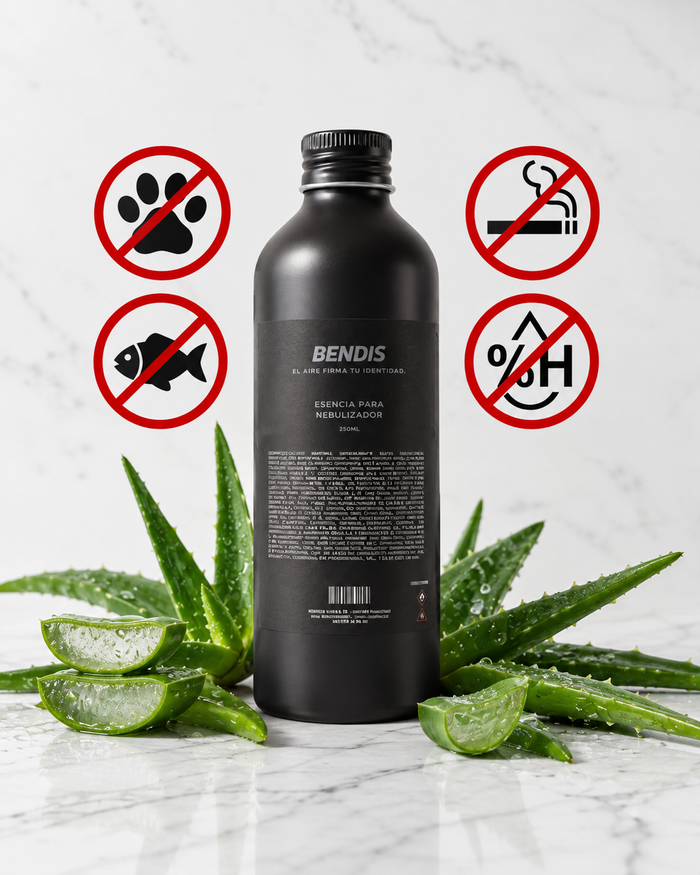
Neutralizing means eliminating the molecules that cause a bad smell (fatty acids and amines from pets, tobacco compounds, damp, volatile compounds from frying) using agents formulated to react with them. The result is not another smell: it is the absence of smell.
Scenting means adding a fragrance to a space that is already clean. If it is done over an active source, the fragrance mixes with the bad smell and the result is perceived as worse than the original problem.
First the source (toilets, kitchen, changing rooms, bin store), then the atmosphere. How neutralization works.
The technologies, and why almost none of them work for a business
Sprays and automatic air fresheners. They produce large particles that fall to the floor within minutes. Useful as a one-off fix, not as a system.
Reed diffusers. They rely on natural evaporation and the ventilation of the space. The reeds become saturated and the intensity drops over the weeks. Very limited real coverage.
Candles. The scent reaches two or three metres from the flame and disappears when it is blown out. They also involve fire, which rules them out in most venues.
Ultrasonic diffusers. They dilute the fragrance in water and produce particles tens of microns in size that fall quickly. They add humidity to the air. Fine for a room, not enough for a venue.
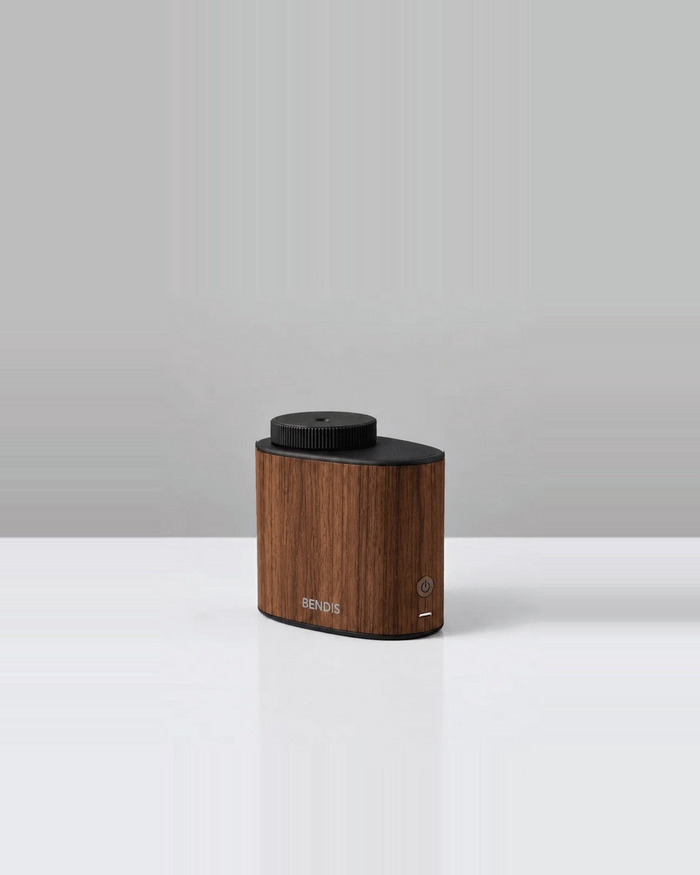
Cold nebulization. Pressurised air atomizes the undiluted fragrance, with no water and no heat, into microparticles of 1 to 10 microns. Because they are so small they stay suspended for hours and cover the volume of the space evenly. It is the technology used by the big hotel chains and the one we use at BENDIS.
How to size a unit
The most common mistake is choosing by price instead of by square metres. An underpowered unit is only noticeable around the device; an oversized one saturates the space and puts people off.
The calculation starts from the real volume of the space (square metres times ceiling height), not just the floor area, and is adjusted for two factors: ventilation (a venue with a door open to the street or powerful air conditioning dissipates the scent faster) and footfall.
The BENDIS range goes from compact units for a toilet or a small reception to models for hotel lobbies, retail spaces and warehouses. There is also a model with a rechargeable battery for spaces without a power socket or for temporary use at events and viewings. See the full catalogue with coverage figures.
For large spaces with ducted air conditioning, the ATMOS and HALO models connect to the HVAC system and use the existing ducts as a distribution network. It is the most even option when there are many square metres and several rooms.
How to choose the scent
There is no universally right scent: there is a scent that is consistent with what your business wants to communicate. Three practical rules:
Consistency. The scent has to support your positioning. A sweet note in a luxury jeweller's communicates the opposite of what you are after.
Discretion. It should be noticed without being identified. The moment a customer thinks «what a strong smell», the intensity is wrong.
Zoning. The lobby, the toilet and the dining room don't need the same thing. In hospitality, the dining room scent must never compete with the kitchen.
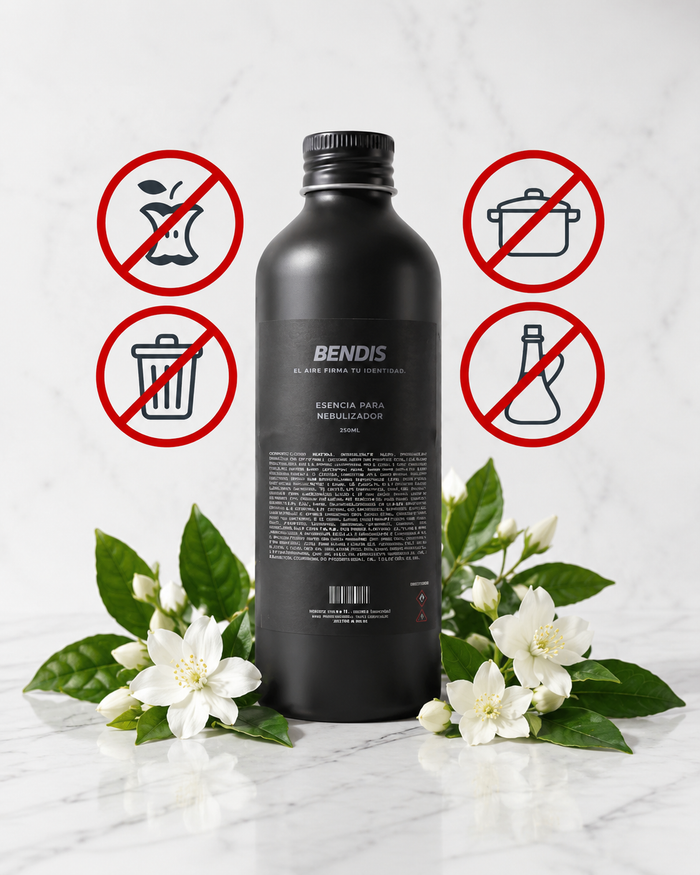
The BENDIS catalogue combines concentrated perfumery fragrances made in Spain with more natural-style notes (lavender, green tea, orange blossom, cinnamon and orange, fig, mint) and specific neutralizers for pets, damp and stale air. Before you decide anything, we send you samples to smell in your own space: the same scent is perceived differently in a bottle than when diffused in a venue.
Sector by sector
Hotels. Reception, corridors, spa and common areas. The first smell on arrival shapes how the whole stay is remembered, and the scent ends up being part of the product: something guests expect to find again. More on hotels.
Restaurants. Three moments: the entrance creates expectation, the dining room accompanies without competing with the food, and the toilets define the perception of hygiene. Toilets first, always: that is where customers judge on their own and where reviews are lost. More on restaurants.
Offices. Coffee area, toilets and meeting rooms. A room still heavy from the previous meeting is a poor first impression for a client or a candidate. More on offices.
Gyms. Changing rooms above all. It is the most frequent image problem in the sector and one of the easiest to solve. More on gyms.
Retail. Scent works on time spent in store and on brand recall when it is repeated across every point of sale.
Clinics. It softens the smell of disinfectant and the tension associated with healthcare settings. Always at low intensity. It is one of the most under-used applications in Spain. More on clinics.
Events and trade fairs. A stand or a presentation is also remembered by how it smells. You may be interested in scent marketing at events, trade fairs and exhibitions.
Buy or pay a monthly fee
Purchase. You buy the unit and the refills separately. It pays off if you have a single point and steady use. Diffuser catalogue.
Monthly scenting plan. What many people search for as diffuser rental: a monthly fee from €29.90/month + VAT per unit, with each month's fragrance included. No minimum term and no upfront investment. It is the usual option when there are several areas or several venues, because the cost is predictable and scalable.
In both cases the unit arrives set up for your square metres and takes five minutes to place. We don't do building work or technical visits: if something fails, it is replaced.
Mistakes that cost dearly
Scenting over a bad smell without neutralizing it first. Turning up the intensity because «I can't smell it any more» (you can't, because of olfactory adaptation; your customers can: ask someone who has just walked in, and do it as they arrive). Changing scent every few months and breaking the brand association. Using a single unit for the whole venue, ignoring that each area has its own problem. And signing long contracts before checking whether the chosen scent works in your space.
How to get started
The starting point is simple: how many square metres, how many areas, whether there is a source of bad smell and what you want people to feel when they walk in. With that, we size the unit and suggest scents. After that it runs on its own, programmed by schedule and intensity.
We work with customers all over Spain, always remotely. If you are in Madrid and comparing suppliers, you may be interested in how to choose a scent marketing supplier in Madrid and what to ask. Opening hours: Monday to Saturday, 10:00 to 20:00.
Call +34 911 09 70 50 or email info@bendis.es.
Service for businesses · By sector and city · Diffuser catalogue